
Berita
Polres Pasuruan Kota Gelar Pers Release Hasil Ungkap Operasi Pekat Semeru 2026

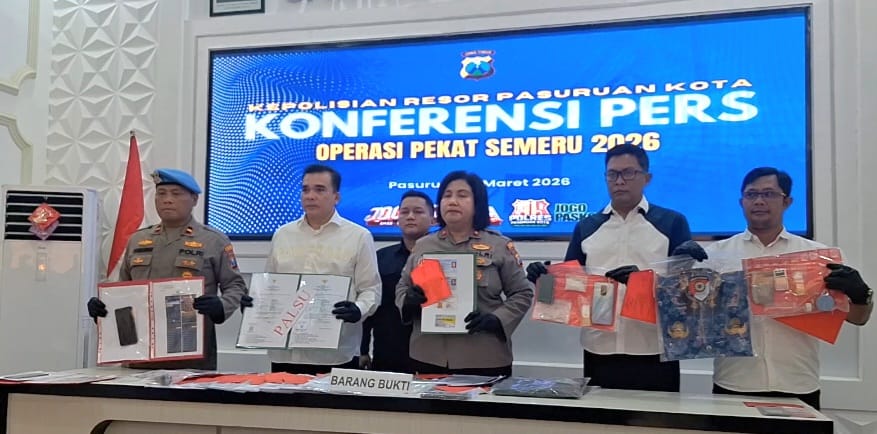
Polresta Pasuruan – Sebagai bentuk transparansi kepada masyarakat terkait capaian kinerja kepolisian dalam memberantas berbagai penyakit masyarakat di wilayah hukum Polres Pasuruan Kota. Pada Hari Rabu tanggal 11 Maret 2026 Polres Pasuruan Kota menggelar kegiatan pers release terkait hasil pengungkapan Operasi Pekat Semeru 2026 di Ruang Rupatama Sanika Satyawada Polres Pasuruan Kota Jalan Gajah Mada 19 Kota Pasuruan.
Kegiatan Pers release dihadiri oleh awak media, dipimpin langsung oleh Wakapolres Pasuruan Kota Kompol Yokhbeth Wally, S.I.K, didampingi oleh Kasat Reskrim, Kasat Resnarkoba serta Kasi Propam Polres Pasuruan Kota. Dalam kesempatan tersebut, Wakapolres memaparkan secara langsung kepada awak media terkait hasil pengungkapan kasus selama pelaksanaan Operasi Pekat Semeru 2026.
Selama kegiatan operasi berlangsung, jajaran Polres Pasuruan Kota berhasil mengungkap sejumlah kasus kriminalitas yang meresahkan masyarakat. Adapun hasil pengungkapan selama Operasi Pekat Semeru 2026 berlangsung di antaranya
- Kasus perjudian sebanyak 3 kasus,
- Penyalahgunaan bahan peledak atau handak 1 kasus,
- Tindak pidana narkoba 4 kasus,
- Aksi premanisme 3 kasus,
- Serta kasus prostitusi sebanyak 1 kasus.
Selain pengungkapan beberap kasus diatas, Satreskrim Polres Pasuruan Kota juga berhasil mengungkap kasus pemalsuan informasi atau dokumen elektronik dan atau penipuan terkait pendaftaran pegawai PPPK sebagaimana terseut dalam pasal 35 jo pasal 51 ayat (1) UU.RI Nomor 11 Yahun 2008 tentang informasi dan transaksi elektronik sebagaimana diubah dengan UU.RI Nomor 1 tahun 2024 tentang Informasi dan Transaksi Elektronik Subs Pasal 492 UU No. 1 tahun 2023 tentang KUHP
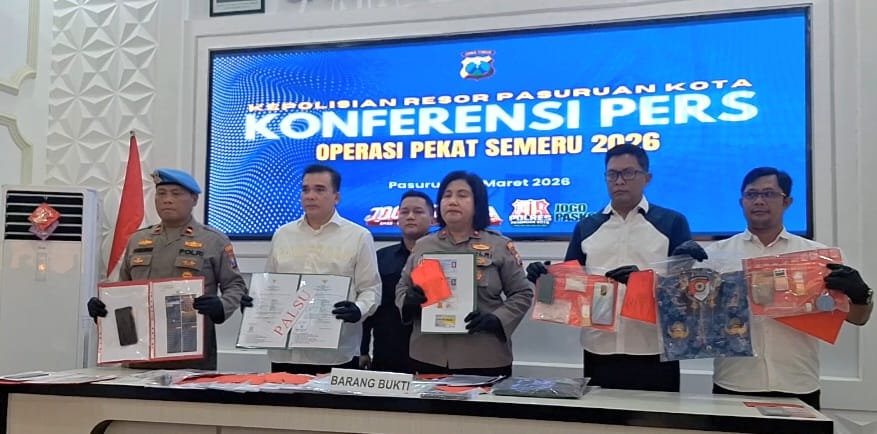
Dalam kasus tersebut, tersangka (TA)melakukan modus dengan mengiming-imingi korban (NK) dapat meloloskan menjadi pegawai PPPK dengan syarat membayar uang pendaftaran sebesar Rp 100 juta. Korban yang percaya kemudian mentransfer uang sebesar Rp75 juta kepada tersangka, namun setelah itu korban tidak pernah terdaftar sebagai pegawai PPPK sebagaimana yang dijanjikan.
Merasa dirugikan, korban (NK) kemudian melaporkan kejadian tersebut ke Mapolres Pasuruan Kota. Menindaklanjuti laporan tersebut, Satreskrim Polres Pasuruan Kota bergerak cepat melakukan penyelidikan hingga dalam waktu dua hari berhasil mengungkap perkara tersebut serta mengamankan tersangka berikut sejumlah barang bukti.
Wakapolres Pasuruan Kota Kompol Yokhbeth Wally, S.I.K menyampaikan bahwa keberhasilan pengungkapan sejumlah kasus dalam Operasi Pekat Semeru 2026 merupakan bentuk komitmen Polres Pasuruan Kota dalam menjaga keamanan dan ketertiban masyarakat.
“Melalui Operasi Pekat Semeru 2026 ini kami berkomitmen untuk menindak tegas berbagai bentuk penyakit masyarakat yang dapat mengganggu keamanan dan ketertiban. Kami juga mengimbau kepada masyarakat agar lebih waspada terhadap berbagai bentuk penipuan serta tidak mudah percaya kepada oknum yang menjanjikan dapat meloloskan menjadi pegawai PPPK dengan imbalan sejumlah uang,” ujar Kompol Yokhbeth Wally.
Saat ini tersangka telah diamankan dan dilakukan penahanan di Mapolres Pasuruan Kota guna menjalani proses hukum lebih lanjut serta mempertanggungjawabkan perbuatannya sesuai dengan ketentuan hukum yang berlaku.

COVID-19 is a contagious disease caused by the coronavirus SARS-CoV-2. In January 2020, the disease spread worldwide, resulting in the COVID-19 pandemic.
The symptoms of COVID‑19 can vary but often include fever,[7] fatigue, cough, breathing difficulties, loss of smell, and loss of taste.[8][9][10] Symptoms may begin one to fourteen days after exposure to the virus. At least a third of people who are infected do not develop noticeable symptoms.[11][12] Of those who develop symptoms noticeable enough to be classified as patients, most (81%) develop mild to moderate symptoms (up to mild pneumonia), while 14% develop severe symptoms (dyspnea, hypoxia, or more than 50% lung involvement on imaging), and 5% develop critical symptoms (respiratory failure, shock, or multiorgan dysfunction).[13] Older people have a higher risk of developing severe symptoms. Some complications result in death. Some people continue to experience a range of effects (long COVID) for months or years after infection, and damage to organs has been observed.[14] Multi-year studies on the long-term effects are ongoing.[15]
COVID‑19 transmission occurs when infectious particles are breathed in or come into contact with the eyes, nose, or mouth. The risk is highest when people are in close proximity, but small airborne particles containing the virus can remain suspended in the air and travel over longer distances, particularly indoors. Transmission can also occur when people touch their eyes, nose, or mouth after touching surfaces or objects that have been contaminated by the virus. People remain contagious for up to 20 days and can spread the virus even if they do not develop symptoms.[16]
Testing methods for COVID-19 to detect the virus’s nucleic acid include real-time reverse transcription polymerase chain reaction (RT‑PCR),[17][18] transcription-mediated amplification,[17][18][19] and reverse transcription loop-mediated isothermal amplification (RT‑LAMP)[17][18] from a nasopharyngeal swab.[20]
Several COVID-19 vaccines have been approved and distributed in various countries, many of which have initiated mass vaccination campaigns. Other preventive measures include physical or social distancing, quarantining, ventilation of indoor spaces, use of face masks or coverings in public, covering coughs and sneezes, hand washing, and keeping unwashed hands away from the face. While drugs have been developed to inhibit the virus, the primary treatment is still symptomatic, managing the disease through supportive care, isolation, and experimental measures.
COVID-19 is a contagious disease caused by the coronavirus SARS-CoV-2. In January 2020, the disease spread worldwide, resulting in the COVID-19 pandemic.
The symptoms of COVID‑19 can vary but often include fever,[7] fatigue, cough, breathing difficulties, loss of smell, and loss of taste.[8][9][10] Symptoms may begin one to fourteen days after exposure to the virus. At least a third of people who are infected do not develop noticeable symptoms.[11][12] Of those who develop symptoms noticeable enough to be classified as patients, most (81%) develop mild to moderate symptoms (up to mild pneumonia), while 14% develop severe symptoms (dyspnea, hypoxia, or more than 50% lung involvement on imaging), and 5% develop critical symptoms (respiratory failure, shock, or multiorgan dysfunction).[13] Older people have a higher risk of developing severe symptoms. Some complications result in death. Some people continue to experience a range of effects (long COVID) for months or years after infection, and damage to organs has been observed.[14] Multi-year studies on the long-term effects are ongoing.[15]
COVID‑19 transmission occurs when infectious particles are breathed in or come into contact with the eyes, nose, or mouth. The risk is highest when people are in close proximity, but small airborne particles containing the virus can remain suspended in the air and travel over longer distances, particularly indoors. Transmission can also occur when people touch their eyes, nose, or mouth after touching surfaces or objects that have been contaminated by the virus. People remain contagious for up to 20 days and can spread the virus even if they do not develop symptoms.[16]
Testing methods for COVID-19 to detect the virus’s nucleic acid include real-time reverse transcription polymerase chain reaction (RT‑PCR),[17][18] transcription-mediated amplification,[17][18][19] and reverse transcription loop-mediated isothermal amplification (RT‑LAMP)[17][18] from a nasopharyngeal swab.[20]
Several COVID-19 vaccines have been approved and distributed in various countries, many of which have initiated mass vaccination campaigns. Other preventive measures include physical or social distancing, quarantining, ventilation of indoor spaces, use of face masks or coverings in public, covering coughs and sneezes, hand washing, and keeping unwashed hands away from the face. While drugs have been developed to inhibit the virus, the primary treatment is still symptomatic, managing the disease through supportive care, isolation, and experimental measures.
tc-manager precheck test1 – https://test1.com
-
 Polres7 hari ago
Perkuat Pondasi Kamtibmas, Kapolres Pasuruan Kota Gelar Silaturahmi Dengan Habib Qodir Assegaf
-
 Berita1 minggu ago
Polresta Malang Kota Edukasi Pelajar tentang Bahaya Kejahatan Siber dan Judol
-
Berita7 hari ago
Sinergi Bhabinkamtibmas Desa Semare dan Perangkat Desa Wujudkan Kamtibmas Aman Kondusif
-
Berita6 hari ago
Polsek Pohjentrek Antisipasi Gangguan Kamtibmas Pada Objek Vital Bank BRI
-
 Berita1 minggu ago
Dukung Swasembada Pangan, Polres Pasuruan Kota Lakukan Pengawasan Lahan Binaan di Kebonagung
-
 Polres4 hari ago
Polres Blitar Kota Luncurkan SPPG Ketapang Layani 886 Penerima Manfaat Program MBG
-
Berita6 hari ago
Perkuat Pondasi Kamtibmas, Kapolres Pasuruan Kota Gelar Silaturahmi Dengan Habib Qodir Assegaf
-
 Berita6 hari ago
Gerakan Tanam Pohon, Polres Bondowoso Hijaukan Bukit Bintang